How to Build a WooCommerce Store That Actually Sells in Egypt and the Gulf

Quick answer
A WooCommerce store that sells in Egypt and the Gulf combines local payment options (cards, Meeza, mobile wallets, instalments and a controlled cash-on-delivery option in Egypt; mada, Apple Pay and buy-now-pay-later in the Gulf) with an integrated courier such as Bosta or Aramex. On top of that it needs a fast mobile site, trustworthy product pages, a short checkout, product SEO and proper sales tracking.
Installing WooCommerce takes an afternoon. Building a WooCommerce store that actually sells takes decisions: which payment gateways your customers trust, how orders reach a courier, how fast the product page loads on a mid-range Android phone, and how few fields stand between the customer and the Place order button. After years of building and rescuing WordPress and WooCommerce stores for clients in Egypt and the Gulf, this is the plan I follow.
What a store that sells really needs
The Egyptian market is large and mobile-first. Mordor Intelligence estimates Egypt's e-commerce market at about USD 11.49 billion in 2026, with smartphones accounting for roughly 72% of transaction value in 2025. The same report puts cash on delivery and bank transfers at around 34% of payment value, while digital wallets are the fastest-growing method. In other words, you must accept both cash and digital money, and your store must be excellent on a phone.
I think of a profitable store as six layers, and a weakness in any one of them leaks sales:
- Payments that match local habits in each country you sell to.
- Shipping that is integrated, trackable and priced clearly.
- Speed on mobile networks, not only on office Wi-Fi.
- Trust built into product pages, policies and contact options.
- Checkout that is short, clear and error-free.
- SEO and analytics so you get found and know where you lose people.
Payment gateways in Egypt for WooCommerce
Choosing a WooCommerce payment gateway in Egypt is about coverage, fees and settlement speed. These are the main options I integrate, based on each provider's own plugin and pricing pages:
| Option | What customers can use | Worth knowing |
|---|---|---|
| Paymob | Cards, mobile wallets, bank instalments, kiosk payments and BNPL providers such as valU, Souhoola, Halan, Aman and Forsa | Official WooCommerce plugin; standard Egypt pricing listed at 2.75% + EGP 3 per card transaction with weekly settlement |
| Kashier | Visa, Mastercard and Meeza cards; bank instalments | Listed at 2.85% + EGP 3 per successful transaction, settled after 3 working days |
| Fawry (FawryPay) | Reference number paid at Fawry outlets, cards and mobile wallets | Useful for customers without cards; add an order expiry time for unpaid references |
| Geidea | Visa, Mastercard and Meeza cards, Meeza wallet | Also operates in Saudi Arabia and the UAE, handy for regional brands |
| InstaPay transfer | Instant bank-to-bank transfer | Usually added as a manual method; confirm the money has arrived before shipping |
| Cash on delivery | Cash to the courier | Still essential in Egypt, but it needs rules to control returns |
Fees and supported methods change, so confirm the current terms in your merchant agreement. For small baskets, remember that the fixed fee raises your effective rate: on a EGP 150 order, EGP 3 alone is 2% on top of the percentage.
Make cash on delivery profitable
Cash on delivery (COD) sells, but refused parcels cost you shipping both ways. In the stores I build, I control it with a few rules:
- Confirm before shipping. Send an automatic WhatsApp or SMS confirmation and only ship confirmed orders.
- Nudge towards online payment. Offer a small discount or free shipping for prepaid orders instead of penalising COD.
- Limit risk. Hide COD above a certain basket value or for areas with high refusal rates, or ask for a deposit on custom items.
- Measure it. Track the delivery success rate per governorate and per product, not only the number of orders.
Payment gateways for Saudi Arabia and the Gulf
Gulf shoppers are more card- and wallet-driven, and they expect specific methods. In Saudi Arabia, mada debit cards and Apple Pay are must-haves, and STC Pay is common. Moyasar's WooCommerce plugin, for example, supports mada, Visa, Mastercard, American Express, Apple Pay, Samsung Pay and STC Pay. Paymob's plugin covers cards, Apple Pay, Google Pay, STC Pay, Tabby and Tamara in Saudi Arabia, and cards, Apple Pay, Google Pay, Tabby and Tamara in the UAE.
- Add buy now, pay later (BNPL) with Tabby or Tamara; instalment badges on product pages lift average order value in fashion, electronics and furniture.
- Price in local currency (SAR, AED, KWD) and show VAT correctly: 15% in Saudi Arabia and 5% in the UAE.
- Most Gulf gateways require a local commercial registration and bank account, so plan the legal entity before the store launch.
- Offer Arabic and English, with right-to-left layout that is tested, not just translated.
Shipping integrations: Bosta, Aramex and others
Manual shipping does not scale. Once you pass a few orders a day, copying addresses into a courier portal causes errors and delays. A proper integration creates the shipment from the WooCommerce order, prints the airway bill, writes the tracking number back to the order and updates the status automatically.
- Bosta: its official WooCommerce plugin supports Egypt and Saudi Arabia, creates deliveries automatically, prints airway bills in bulk, handles COD orders and pickup requests, and syncs statuses through webhooks. Reviews mention gaps in city and area mapping, so test every governorate you ship to.
- Aramex: strong for Gulf and cross-border shipping. Note that the official Aramex extension is no longer sold on WooCommerce.com, so use a maintained third-party plugin or a direct API integration.
- Other couriers such as Mylerz in Egypt, or SMSA and Naqel in Saudi Arabia, can be connected through their APIs or plugins where available.
Set shipping zones by governorate or city, show the delivery fee and expected delivery days on the product page, and consider a free-shipping threshold slightly above your average order value. Baymard's research found that 20% of shoppers who abandon checkout do so because delivery was too slow.
Speed: the silent conversion killer
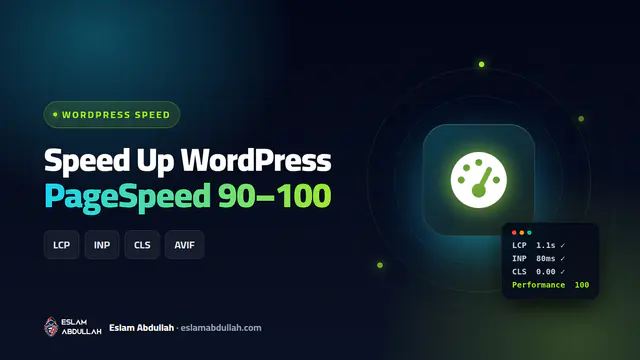
A slow store loses buyers before they see the price. Aim for Google's "good" Core Web Vitals thresholds on product, category and checkout pages: Largest Contentful Paint (LCP) under 2.5 seconds, Interaction to Next Paint (INP) under 200 ms and Cumulative Layout Shift (CLS) under 0.1.
- Use quality hosting with PHP 8.x, object caching (Redis) and a CDN; shared hosting struggles when campaigns bring traffic spikes.
- Keep WooCommerce's High-Performance Order Storage (HPOS) enabled; it has been the default for new stores since WooCommerce 8.2.
- Serve product images in WebP or AVIF, sized correctly, with lazy loading below the fold.
- Cache pages, but exclude cart, checkout and my-account pages.
- Remove plugins you do not need and avoid heavy page builders on product templates.
I explain the full process in my WordPress speed optimisation guide, and you can see the same approach on this site, which scores 97 to 100 on mobile PageSpeed.
Product pages that build trust
In Egypt and the Gulf, shoppers are cautious with new online stores. Baymard found that 19% of shoppers who abandon checkout did not trust the site with their card details. Trust is built on the product page long before payment:
- Several real photos, including scale and detail shots, plus a short video when possible.
- Clear Arabic (and English) descriptions written for the customer: sizes, materials, warranty and what is in the box.
- Price, delivery fee, delivery time and return policy visible near the Add to cart button.
- Verified reviews with photos, and a visible WhatsApp or phone contact.
- A real company name, address and registration details in the footer and on an About page.
- HTTPS everywhere and a secure, updated site. A hacked store loses trust overnight, which is why I pair every build with security hardening.
A checkout that converts
Baymard's benchmark puts the average documented cart abandonment rate at about 70%. The top reason is extra costs that appear too late (40%), followed by slow delivery, lack of trust, forced account creation (18%) and a long or complicated checkout (17%). Baymard also estimates that better checkout design can raise conversion by about 35%.
- Allow guest checkout. Offer account creation after the order, not before.
- Cut the fields. For Egypt you usually need name, mobile number, governorate, city or area, and street address. Remove company, postcode and second address lines unless you need them.
- Show the total early. Calculate shipping as soon as the governorate is selected.
- Put the favourite method first. Cards and wallets in the Gulf; cards, wallets and COD in Egypt, with logos customers recognise.
- Recover abandoned carts. A WhatsApp or email reminder with a direct link back to the cart recovers orders you already paid to attract. I build these flows with n8n automation.
- Test on real phones with every gateway in sandbox mode before launch, then with a real low-value order.
SEO and analytics for WooCommerce
Get found
- Research Arabic and English keywords separately; Egyptian shoppers often search in Egyptian Arabic or in Franco-Arabic.
- Write unique category and product descriptions; never paste the supplier's text.
- Add Product structured data with price, availability and reviews, and submit a product feed to Google Merchant Center.
- Use clean URLs, a logical category structure and internal links from blog content to categories.
Measure everything
Set up Google Analytics 4 e-commerce events (view item, add to cart, begin checkout, purchase), the Meta pixel with the Conversions API for ad attribution, and a simple weekly report: sessions, conversion rate, average order value, COD delivery success and refund rate. The data tells you which leak to fix first.
Quick test: if many visitors add to cart but few begin checkout, your shipping costs or trust signals are the problem. If many begin checkout but few pay, look at the form, the payment step and gateway errors.
What it costs and how I can help
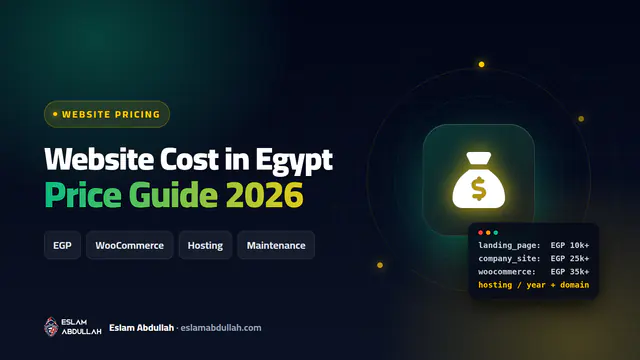
These are approximate 2026 market ranges in Egypt, not my price list. For a detailed breakdown, read how much a website costs in Egypt in 2026.
| Store type | Approximate range (EGP) | What drives the price |
|---|---|---|
| Template-based starter store | 15,000 to 40,000 | Few products, ready theme, one gateway, manual shipping |
| Custom-designed WooCommerce store | 40,000 to 120,000 | Custom design, several gateways, courier integration, speed and SEO setup |
| Advanced or multi-country store | 120,000 to 350,000+ | ERP or inventory sync, Gulf payments and currencies, custom features, automation |
Budget separately for hosting, premium plugin licences, gateway fees and ongoing maintenance. I build WooCommerce stores with local payments, shipping, speed and security included, and I also offer speed optimisation for existing stores. Browse my portfolio or tell me about your products and markets for a clear plan and quote.
Key takeaways
- Most Egyptian shoppers buy on their phones, so design and test the store mobile-first and aim for good Core Web Vitals on product and checkout pages.
- Offer the payment methods your market trusts: Paymob, Kashier, Fawry or Geidea in Egypt, plus a verified cash-on-delivery flow; mada, Apple Pay, Tabby and Tamara in Saudi Arabia and the UAE.
- Integrate shipping (Bosta, Aramex or another courier) so orders create shipments, tracking numbers and COD collection automatically.
- Baymard puts average cart abandonment at about 70%, and surprise extra costs are the top reason, so show delivery fees and the total early.
- Track every step with GA4 e-commerce events and fix the biggest leak first instead of redesigning everything.
Frequently asked questions
What is the best payment gateway for WooCommerce in Egypt?
There is no single best option. Paymob covers the widest range of methods, including cards, wallets, kiosk payments and BNPL such as valU; Kashier is a solid card and Meeza option with quick settlement; Fawry suits customers who pay cash at outlets. Many stores combine one gateway with cash on delivery.
Can I accept InstaPay on a WooCommerce store?
Most stores add InstaPay as a manual payment method: the customer transfers to your InstaPay address and sends proof, and you confirm receipt in your bank app before shipping. For fully automatic confirmation, use a gateway that supports the wallet or instant methods you need.
How do I connect Bosta shipping to WooCommerce?
Install the official Bosta WooCommerce plugin, add your Bosta API key, map your cities and areas, and choose which order statuses create deliveries. The plugin can create shipments, print airway bills in bulk, handle cash on delivery and sync tracking statuses back to your orders.
Which payment methods do I need to sell in Saudi Arabia and the UAE?
At minimum, cards with mada in Saudi Arabia plus Apple Pay. Adding STC Pay in Saudi Arabia and buy now, pay later providers such as Tabby or Tamara usually improves conversion. Gateways like Moyasar, Paymob and Geidea support these methods, subject to local merchant approval.
How can I reduce cart abandonment on my WooCommerce store?
Show shipping fees and the total early, allow guest checkout, reduce the checkout to the essential fields, offer the payment methods your market trusts, make the site fast on mobile and send WhatsApp or email reminders to recover abandoned carts.
Need a hand with this?
I can do it for you – fast, secure and done right the first time. Free consultation on WhatsApp.